
AGROCARBON SERIES · COFFEE VOLUME · CASE STUDY
COFFEE: A SECOND LIFE
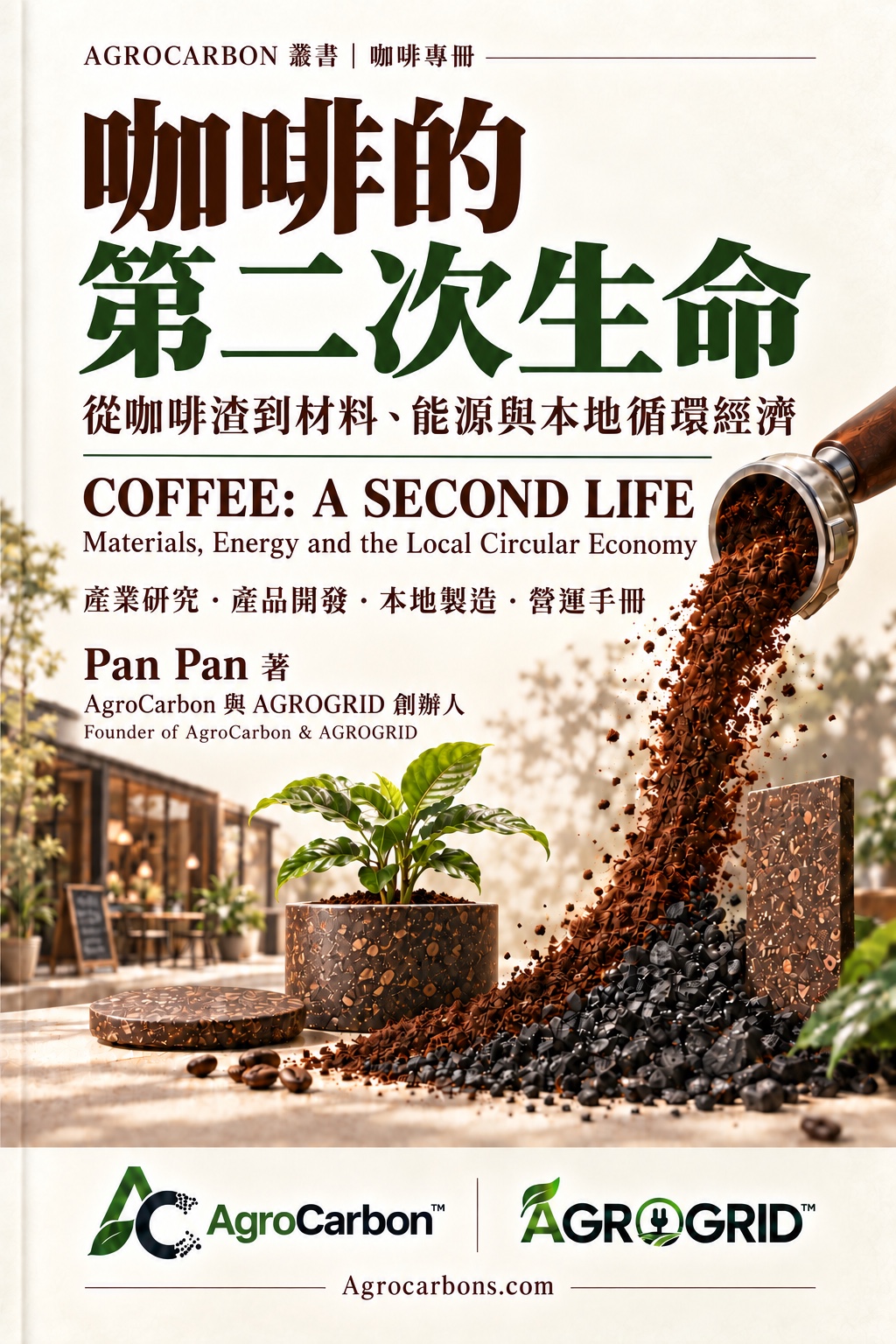
《咖啡的第二次生命》
Materials, Energy and the Local Circular Economy
A practical research and implementation framework connecting café collection with material processing, product manufacturing and local use.
One material stream. A complete local system.
Coffee is a case study within the wider AgroCarbon platform, which covers husks, shells, stalks and other agricultural residues. This book follows coffee through collection, processing, manufacturing and local application.
Book in development. The contents below are the updated outline. Cover products are concept illustrations.
After coffee is sold, the value chain continues.
After a cup of coffee is sold, the bill is settled, but the material journey continues. The grounds left in the café still need sorting, handling, storage and treatment. They may remain a disposal cost—or become a local feedstock.
Years of working across manufacturing and markets invite a renewed question: must feedstocks, processing, manufacturing and use always be so far apart? When transport, energy and external supply conditions shift, local circular systems become practical again.
Coffee: A Second Life follows four principles: local collection, local processing, local manufacturing and local use.
The book places business questions alongside technical ones. Who pays for collection? How does moisture affect drying costs? Who funds molds and equipment? When should a pilot continue, and when should it pause?
Pan Pan · Founder of AgroCarbon & AGROGRID
Coffee brands and operators; sustainability and procurement teams; processors and manufacturers; engineers; investors and local governments.
Operators: Parts II–IV and VII. Engineers: Parts IV–VI. Investors: Parts II, VIII and X. Brand teams: Parts VI and IX.
From the first collection to a working business.
Expand each part to see its chapters and scope. These are planned chapter descriptions, not completed operating procedures or validated manufacturing recipes.
01Coffee’s second value chain
Coffee life cycle, residue-generation points, participants and value distribution.
02Understanding coffee residues
Distinguishing grounds, fruit husks, processing by-products and roasting silverskin.
03Coffee grounds as an industrial feedstock
Moisture, particle size, composition, odor, contamination and batch consistency.
04A technology map from feedstock to product
Powders, composites, char, horticulture, adsorbents, textiles and energy.
05Building a local circular system
Feedstock distribution, collection distances, processing capacity, local buyers and end-of-life handling.
Tools for implementation.
Planned toolkit scope. This page lists the intended forms and templates; it does not yet distribute completed tool files.
A | Project surveys and cooperation
- • Café feedstock surveys and buyer-requirement forms
- • Site and processing-partner assessment forms
- • Pilot plans, responsibility matrices and acceptance forms
B | Cafés and collection
- • Café instruction cards and sorting photo guides
- • Container labels and weighing/handover forms
- • Route sheets, vehicle-cleaning and incident reports
C | Factory and production
- • Receiving, sampling and testing records
- • Dewatering, drying, milling and production-batch records
- • Process cards, formulations, cleaning and maintenance forms
- • Nonconformity and corrective-action records
D | Product development and delivery
- • Manufacturing dossiers and bills of materials
- • Equipment and mold inquiry specifications
- • Test plans, trial reviews and dispatch checklists
- • Labels, instructions and sample product passports
E | Operations and investment
- • Startup-budget, unit-cost and cash-flow templates
- • Inventory, order and daily operating reports
- • Monthly-performance and expansion-decision forms
F | References and terminology
- • Source references and evidence index
- • Image credits, real-photo and concept-design descriptions
- • Chinese–English terminology, units and conversions
Make the source clear. Make the result verifiable.
Measured data, supplier quotations, research findings and planning assumptions are identified separately. Product status distinguishes concepts, experimental samples, pilot production and commercial supply.